
300+ Satisfied Clients In 5+ Countries
CLINICS:
More Than an AI Receptionist — A Complete Enquiry Handling System for Clinics
We install a 3-Stage Front Desk System That Handles Calls, Website Enquiries, Bookings, Follow-ups, and Reviews
Watch the 3 minute demo below of Stage 1 - Automated Call Handling
Answering Calls Isn’t the Hard Part Anymore

Most AI receptionist tools can answer calls.
Many can even book appointments.
The real problem clinics face is what happens before and after the call and how leads and clients are handled.
Leads move onto the next business because you are not responding quick enough
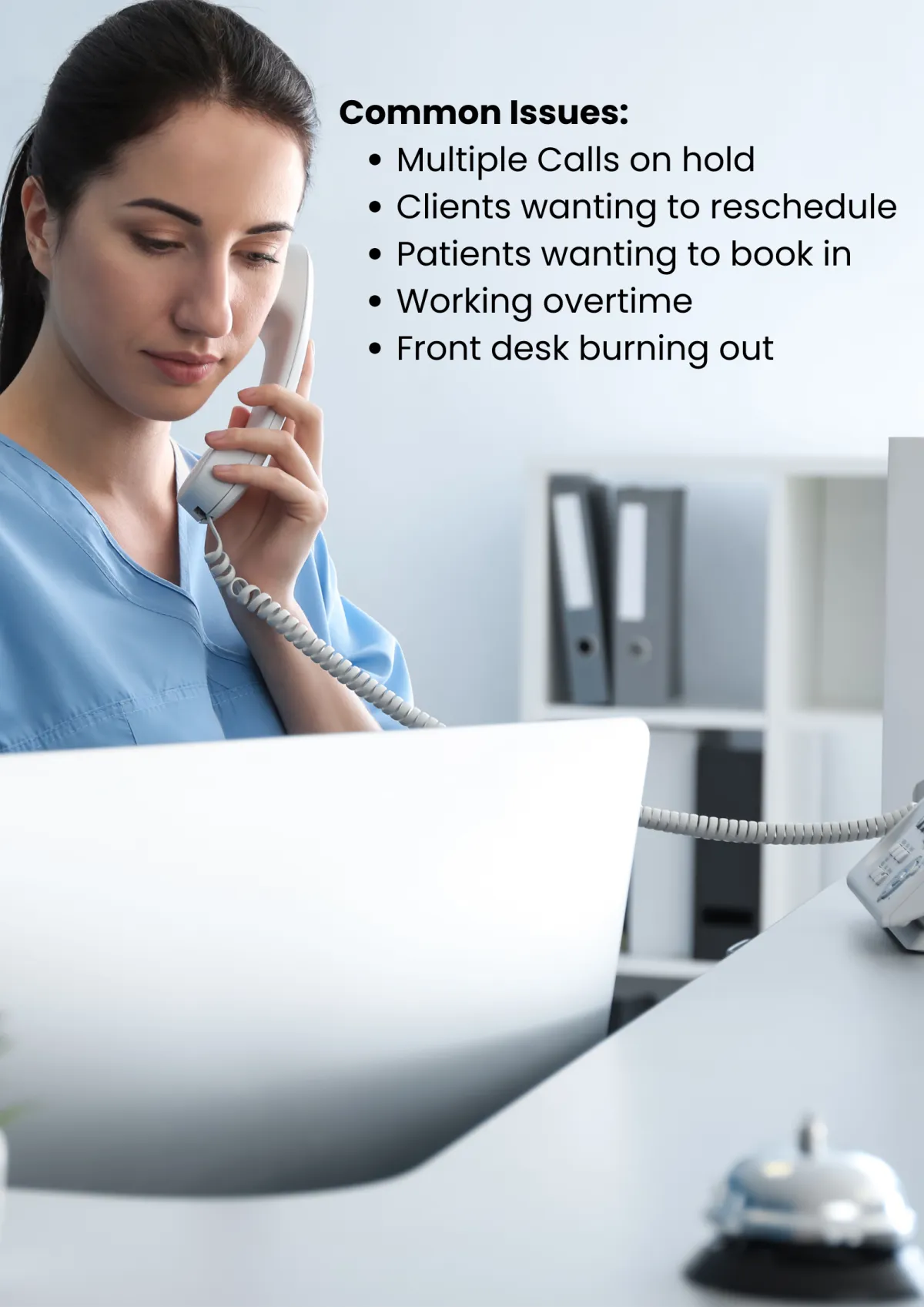
Staff with clients and can’t pick up new calls and answer enquiries
Website landing page and homepage are not converting properly
Phones ringing unanswered therefore leaving money on the table
After-hours enquiries going to voicemail
Messages taken, but not followed up properly
Existing clients are not being nurtured correctly and therefore are missing repeat business
Good automations are not in place to ensure enquiries are always
handled, clients are always nurtured, and time is freed up
The clinic is working hard. The system just isn’t built for volume.
What Makes This Different
This is not just another AI receptionist.
It’s a managed front desk system that:
captures leads both via calls and website
optimizes and enhances your online presence for higher conversion
improves your online reputation
Calls are only one channel.
The system manages the entire front-desk process.
What's Included (Beyond Calls)
Depending on your stage, the system can include:
Dedicated enquiry landing pages
Short qualification or assessment forms
AI website chat for after-hours enquiries
Automated SMS confirmations and follow-ups
Central inbox for calls, forms, chat, and messages
Automated Google review prompting
Everything flows through one structured process.
THE SIMPLE FIX
How the 3-Stage System Actually Works
Stage 1 — Answer & Capture
Calls are answered instantly when reception is busy or unavailable.
Patient details and reason for calling are captured.
Stage 2 — Handle & Follow Up
Appointments are booked.
Messages are sent.
Follow-ups and reminders happen automatically.
Everything is logged in one place.
Site visitors can chat with AI also
Patients are prompted to leave a review.
Stage 3 — Manage & Optimise (Advanced)
Enquiries are routed correctly.
Low-value noise is filtered.
The system improves how demand is handled.
Website intake assessments filter enquiries.
Most clinics start with Stage 1 and 2.
You save on resources
Save $$ without hiring more receptionists
Make more $$ because you are able to handle more enquiries and take in more patients
What This Actually Changes for Your Clinic
Fewer missed patient enquiries
Fewer no-shows
Less pressure on reception
Clear visibility on all enquiries
Better patient experience
More reviews without chasing
This is why clinics move away from “just an AI receptionist”.
What Most Clinics Start With
Most clinics activate Step 2: intake handling — which includes:
Call answering
Appointment booking
Central enquiry inbox
Automated follow-ups
Review request automation
It replaces multiple tools and manual processes with one system.
Case Study How a Busy Clinic Stopped Losing Patient Enquiries Without Hiring More Staff
The Clinic
A multi-disciplinary clinic offering allied health services with a busy front desk and regular after-hours enquiries.
The clinic already had:
online bookings
reception staff
voicemail after hours
But enquiries were still slipping through.
The Problem
During peak periods, reception staff were:
already on the phone
dealing with patients at the desk
trying to juggle bookings, reschedules, and questions
After hours, calls went to voicemail.
Patients rarely left messages.
Many called another clinic instead.
The clinic also noticed:
missed follow-ups
no clear visibility on which enquiries were handled
inconsistent review requests
growing admin pressure as demand increased
Hiring another receptionist wasn’t cost-effective.
Using a basic AI receptionist didn’t solve the follow-up and visibility issues.

The Solution
The clinic implemented a 2-step intake handling system:
Call Handling
Calls answered automatically when reception was busy or unavailable
Patient details and enquiry reason captured
Booking & Follow-Up
Appointments booked directly into the clinic calendar
Automated confirmations and reminders sent
Missed-call follow-ups handled automatically
Central Enquiry Inbox
All calls, messages, and bookings logged in one place
Reception could quickly see what had already been handled
Review Requests
Patients automatically prompted for reviews after appointments
No changes were required to how the clinic operated day-to-day.
The system worked quietly in the background.
The Outcome
Within weeks, the clinic saw:
Fewer missed patient enquiries
Reduced phone congestion during peak hours
Less pressure on reception staff
Clear visibility on inbound enquiries
More consistent review collection without manual chasing
The clinic didn’t need more people — it needed a better system for handling demand.
Clinic feedback
“It took the pressure off reception without changing how we run the clinic.”
Why This Worked
Instead of just answering calls, the system:
handled the enquiry end-to-end
reduced reliance on staff availability
ensured nothing went unanswered or unfollowed
This is what moved the clinic beyond a basic AI receptionist.
Important clarification
We did not replace the clinic’s booking system
We did not remove human reception
The system handled overflow, after-hours, and first-touch enquiries
Staff remained in control at all times
How this fits into Squarebox Flow
The automated voice receptionist is one part of a broader intake system:
Calls are answered
Enquiries are logged
Follow-up happens automatically
No-shows and reviews are handled later
But for clinics, the phone is where the biggest leak usually is — and this fixes it first.
What Does It Really Cost to Handle Enquiries?
Get Your FREE Demo Now - Schedule A Call Below
"Our first weekend & our automated call handler booked 21 appointments we'd probably have missed"
Big Smiles Clinic
✅ 24/7, ✅ Sounds human, ✅ No new system to learn
300+
Clients Trust Us
Frequently Asked Questions
Still Have a
Question?
If you have any further questions or need assistance, our team is ready to help.
What exactly is included in this system?
This is a complete enquiry handling system, not a single tool.
Depending on your plan, it can include:
Call handling when your team is busy or unavailable
Appointment or booking management
Website chat and SMS enquiry handling
Central inbox for all enquiries
Automated follow-ups and confirmations
Review request automation
Enquiry routing and prioritisation
Integrations with calendars and existing systems
Everything is designed to work together, so enquiries are captured, handled, followed up, and tracked in one place.
Is this just an AI receptionist with extra features?
No — and this is the key difference.
AI receptionist tools typically:
- answer calls
- take messages or basic bookings
stop there
This system manages the entire enquiry journey, not just the first interaction.
The value comes from:
- what happens after the enquiry
- how follow-ups are handled
- how visibility is maintained
- how demand is managed as volume grows
That’s why it’s sold as a system, not a per-minute tool.
What problems does this actually solve?
Most businesses don’t struggle because they lack tools — they struggle because enquiries are:
missed
handled inconsistently
forgotten
spread across multiple channels
dependent on staff availability
This system solves that by:
centralising all enquiries
automating follow-ups
reducing manual handling
creating consistency, even when you’re busy
We already use multiple tools — why would we switch?
Many businesses already use:
an answering service
online booking software
reminder tools
review tools
shared inboxes
The problem isn’t the tools — it’s that they don’t talk to each other.
This system replaces or connects those tools into one workflow, reducing admin and preventing things from falling through the cracks.
How is this different from cheaper AI or SaaS tools?
Lower-cost tools usually:
do one thing well
require setup, management, and troubleshooting
leave the rest to you
This is a managed system, meaning:
it’s configured for your business
it’s monitored and refined
it works across multiple channels
it doesn’t rely on you to maintain it
You’re paying for outcomes and reliability, not just software access.
How does pricing work?
Pricing is based on:
how much of the system you activate
how much handling and automation you need
the level of complexity in your workflows
For most businesses, this costs significantly less than:
- hiring additional staff
- outsourcing enquiry handling
- paying for multiple disconnected tools
All pricing is shown clearly before activation.
Are there contracts or long-term commitments?
No.
All plans are:
month-to-month
no lock-in contracts
You can upgrade, downgrade, or cancel as your needs change.
How long does setup take?
Most setups are live within:
7–14 days for standard systems
21–45 days for more advanced configurations
Timing depends on access to calendars, phone routing, and existing systems.
Will this work with our existing software?
In most cases, yes.
The system can integrate with:
calendars
booking tools
CRMs
practice or workflow software (where supported)
If something can’t be integrated directly, we design around it.
Do we need to manage this day to day?
No.
The system runs in the background.
You’ll have visibility over enquiries and outcomes, but there’s no requirement to manage workflows or automation daily.
What happens if enquiry volume increases?
The system is designed to scale.
As demand grows, you can:
increase capacity
activate additional features
move to a higher tier
There’s no disruption to service.
Is this suitable for small businesses or only large ones?
Both.
Smaller businesses often start with basic handling and automation.
Larger or busier businesses activate more advanced routing and qualification.
The system grows with you.
How do we know if this is the right setup for us?
The fastest way is to:
see how enquiries would be handled using the system
get a recommendation based on your business
That’s why we start with a short fit check before activation.
What’s the best way to get started?
You can:
See how your enquiries are handled (short quiz)
Book a walkthrough to discuss your setup
If you already know what you want, you can activate your system instantly.
Is this difficult to set up or manage?
No. The system is set up once, refined as needed, and then runs quietly in the background. There’s no daily management required.
What happens if the call answering system goes down?
Systems don’t call in sick, take breaks, or forget to follow processes. In the rare event of an outage, calls can revert to your existing setup.
Is this just another AI trend?
This isn’t about trends or hype. It solves a simple, long-standing problem: missed calls, inconsistent intake and lead filtering.
When is the best time to implement this?
The sooner it’s in place, the sooner missed opportunities stop slipping through the cracks. Missed enquiries don’t wait for a “better time.”
© Copyright 2026. Website By Squarebox Flow. All rights reserved.